"...one shared goal - greater academic success for the broadest possible student population."

Carol Ann Tomlinson, The Differentiated School

Monday, January 28, 2013

Thinking Metaphorically


HOW TO LOOK AT THINGS A DIFFERENT WAY

When Pablo Picasso, the Spanish artist, was a schoolboy, he was terrible at math because whenever the teacher had him write a number on the chalkboard, he saw something different. The number four looked like a nose to him and he kept doodling until he filled in the rest of the face. The number 1 looked like a tree, 9 looked like a person walking against the wind, and 8 resembled an angel. Everyone else in the classroom saw numbers on the chalkboard; Picasso perceived a variety of different images.

Creativity, no matter which of its many definitions you favor, requires looking at the world in a different way and trying fresh approaches to problems. An easy way to shake up your thinking is to think metaphorically. A metaphor is a figure of speech in which a word or phrase that means one thing is used to describe an object or idea to which it is not literally applicable - a ship to plow the sea, for example, or a lover’s lane described as a ribbon of moonlight.

The ability to think metaphorically increases the likelihood that one can appreciate it in a new light, which, in turn, may lead to solutions that might not otherwise be anticipated.The American research team struggling to understand the theories of superconductivity worked in conjunction with a dance troupe to see if they could grasp the choreography of how sub-atomic particles paired and interacted. Physicist Edward Witten – to explain “string theory”– the most revolutionary idea in physics in more than half a century – likened the tiny loops or closed “strings” to doughnuts.

Aristotle considered metaphor a sign of genius, believing that the individual who had the capacity to perceive resemblances between two separate areas of existence and link them together was a person of special gifts. If unlike things are really alike in some ways, perhaps, they are so in others.

Thinking metaphorically opens your eyes to see the similarities between dissimilar things - a technique available to any of us. All we need do is cultivate a taste for metaphor.

-from an article posted at creativethinking.net


When we ask students to compare a math, science or poetry concept in class with something unusual, they need to fully understand it. Breaking it down and analyzing the individual pieces will help them to understand the conecpt better or make it more familiar. So, when Cindy Babauta went looking for a differentiated activity to provide for  a few students who had passed their cells unit pretest, we made them think in metaphors.

CELL ANALOGY COLLAGES

The two students were provided the requirements of the collage via Edmodo, so they could access information anywhere and communicate with me if they had questions or concerns. Basically, the girls had to find representations of everyday objects that had similar functions as several cell structures. Then they had to write an analogy to show the similarity between the cell structure and the everyday object, along with reasoning to explain the comparison. To extend their thinking, we asked them to consider a theme to tie all the objects together. Here is what the girls created:


A.P. compared a plant cell to a well functioning home.


The mother is the nucleus of the home!
H.G.decided a plant cell was similar to a city.          

A toll both operates much like a cell membrane.


Sunday, December 16, 2012

So What Do They Mean by Quantitative Measures?


Quantitative - capable of being measured (dictionary.com)

I always have to stop myself and think about which word I need to use: quantitative or qualitative?  Quality vs. Quantity?  Usually in my family this question would be central to a discussion about an eating establishment.  :-)  But, in this case, it's the two ideas that have been tumbling around in my head as I have been reading Text Complexity:  Raising Rigor in Reading.  Today, I'm trying to make sense (by writing here for myself and anyone else who might make the time) of the quantity piece of text complexity and what it means for helping kids self selective books and teachers choose books for instruction and mentor texts.

Funny thing is, quantitative measures are not easy for us as humans to come by on our own.  They are the measures that focus on word length, sentence length, high frequency words, semantics and sentence complexity.  As early as the 1920s,  researchers who have developed readability formulas, take these variables into account to help determine a text's complexity.  And though quantitative measures would not be something easy for use to do ourselves, computers have made it so that quantitative measures are some of the easiest information for us to obtain (and maybe rely on too much) about a book.  The goal according to the CCSS is to...

"systematically raise the quantitative expectation of text complexity systematically from elementary school so students in high school are prepared for the kinds of reading necessary in college and in many careers."

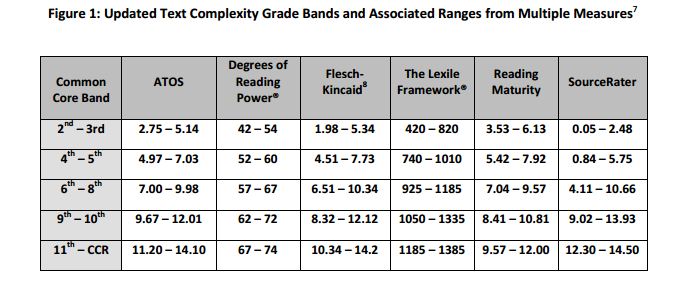
Have you seen what's expected from the CCSS?  The following is a table of the most common quantitative measures used in the field of publishing and education.    They each go about formulating reading levels a little differently.  The one that might be most familiar to you is the ATOS level used by Renaissance Learning (AR).  One that I'm seeing referred to more and more often in conversations about the CCSS is the Lexile level.  What you are seeing in the table below is how each measurement has been adjusted to try to meet the goal set by the CCSS in raising the bar.  Click on the table's caption for more information directly from the source.


Supplemental Information for Appendix A of the Common Core State Standards for English Language Arts and Literacy: New Research on Text Complexity
 
The one thing we've always sensed about these kinds of measures is that they only predict so much about a deep and rich text.  We know that some books have many levels of understanding and that sometimes simple fables can have a very complex idea embedded in them or a book  like The Hunger Games is probably not appropriate for most 5th graders, though many measurements put it at a 5th or 6th grade reading level.  A couple of red flags this book has also raised are that sometimes signal words, which might increase a books reading level, can also help a reader to understand the content and structure of a nonfiction text and that readability levels are really hard to target for emergent readers.  You'll notice on the chart above that the reading levels start in 2nd grade when students would be making the transition from a lot of effort in decoding to more effort in comprehension.

The big thing for me, in reading this section on quantitative measures, is that there is more to a book that we can first measure.  The subject of the book, what the reader will bring to the text, and so many other factors will impact the true readability of a book and a reader's ability to comprehend it.  I have knowledge and control over more of these factors than a computer program.  Though I can use readability measures as one tool for matching books to readers and instruction, I should not rely on it solely.  It should be given it's proper weight and power in the decision.

Ok, so hopefully somewhere along the way you've been asking yourself...so how exactly do these new complexity goals translate into books on my classroom library shelves?  How close to the mark am I in getting these books into the hands of my students?

Here's a link to a list of familiar titles.

Here's where you can go to put in any title and check out its Lexile Level.

This is a super long post.  Maybe it's just for me.  That's ok too.  The bottom line?  Quantitative measures are truly only a first filter on a book's readability.  The richer measures, the more time consuming measures, I'll tackle next.

Angie